Cutting Disposal Costs by $438,000 with On-Site Bioremediation
Overview
Managing nearly 6,000 cubic yards of oil-based drill cuttings in the Midland Basin posed a significant challenge—high disposal costs, environmental risk, and heavily saturated waste that was difficult to handle.
Instead of relying on traditional trucking and landfill disposal, an environmental services provider implemented a bioremediation and recycling program that reduced hydrocarbons on-site and cut total project costs by over $400,000.
By combining biological treatment with mechanical processing and on-site recycling, the operation reduced total petroleum hydrocarbons (TPH), minimized environmental liability, and significantly lowered overall waste management costs compared to conventional disposal methods.
Benefits
- Rapid reduction of TPH in both in-pit and ex-situ treated materials
- Significant cost savings compared to trucking and disposal alternatives
- Reduced environmental liability through on-site treatment and reuse
- Effective treatment of highly saturated and difficult waste streams
- Production of reusable base materials, offsetting future construction costs
- Flexible application for both in-pit and containerized treatment scenarios
Application
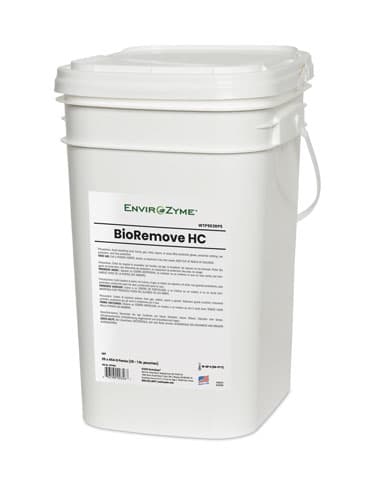
An environmental services provider implemented a combined in-situ and ex-situ bioremediation approach using a bioaugmentation program featuring BioRemove HC, EnviroZyme’s solution designed to support the breakdown of hydrocarbon-based contaminants.
Approximately 5,890 cubic yards of oilfield waste—including oil-based drill cuttings, contaminated soil, and activated sludge—were treated as part of this project.
Treatment Approach
1. Segmentation of Waste
Less saturated material was excavated and transferred into open-top treatment boxes, while highly saturated waste remained in the pit where excavation was not practical.
2. In-Pit vs. Ex-Situ Strategy
- ~1,925 cubic yards treated in open-top boxes (four units, ~200 bbl capacity each)
- ~4,590 cubic yards treated directly in the pit
3. Bioaugmentation with BioRemove HC
Water and activated biological treatment solutions, including BioRemove HC, were applied to stimulate hydrocarbon degradation across both treatment environments.
4. Mechanical Mixing & Activation
Excavators and loaders were used to ensure uniform distribution of treatment solutions, supported by continuous treatment cycles and staged activation tanks.
5. Final Stabilization & Reuse
Treated material was stabilized using aggregate and cement, producing reusable base material suitable for future construction applications.
Results
The bioremediation program delivered measurable improvements in both treatment performance and overall project economics within a relatively short timeframe.
The project was completed in 31 working days, including mobilization, with successful treatment of both highly saturated in-pit material and less saturated waste processed in open-top boxes. This demonstrated the flexibility of the approach across varying waste conditions.
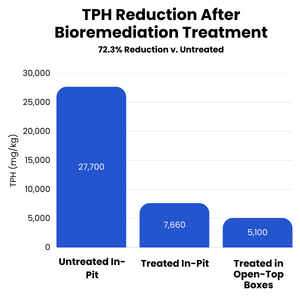
Untreated in-pit material measured 27,700 mg/kg TPH, while treated material decreased to 7,660 mg/kg. Material treated in open-top boxes showed further reduction to 5,100 mg/kg. This represents an approximate reduction of 20,000 mg/kg.
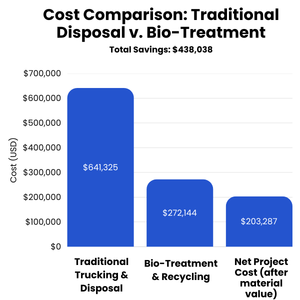
In addition to treatment performance, the program delivered substantial cost savings compared to traditional waste handling methods. The estimated cost for trucking and disposal was $641,325, while the total cost for bio-treatment and recycling was $272,144. After accounting for the value of the recovered base material, the net project cost was reduced to $203,287, resulting in overall savings of approximately $438,000.
The production of reusable base material provided additional value, estimated at approximately $68,857, with the potential for further savings if a greater portion of the treated material were recycled.
Conclusion
By combining EnviroZyme’s BioRemove HC with a flexible treatment approach, this project demonstrates how operators can reduce environmental liability, accelerate remediation timelines, and turn oilfield waste into a cost-saving asset—rather than a disposal burden.
The ability to treat waste both in-pit and in controlled environments provides critical operational flexibility, particularly for highly saturated materials that are difficult to excavate. Converting treated waste into reusable base materials further enhances sustainability by reducing disposal requirements and offsetting future material costs.
BioRemove HC supports the biological breakdown of complex hydrocarbons, helping enhance remediation performance in challenging oilfield applications while maintaining efficient and cost-effective operations.